How the term mark is worked out
Schools combine continuous assessment and the end-of-term exam in different ways, and there is no single right answer. This guide shows how to tell ZamSkools which way your school does it, so every learner's term result matches the way you have always graded.
Where to find it
Sign in as the school administrator or head teacher → School Settings → “How the term mark is worked out”. Pick the shape that matches your school, set the shares, and save.
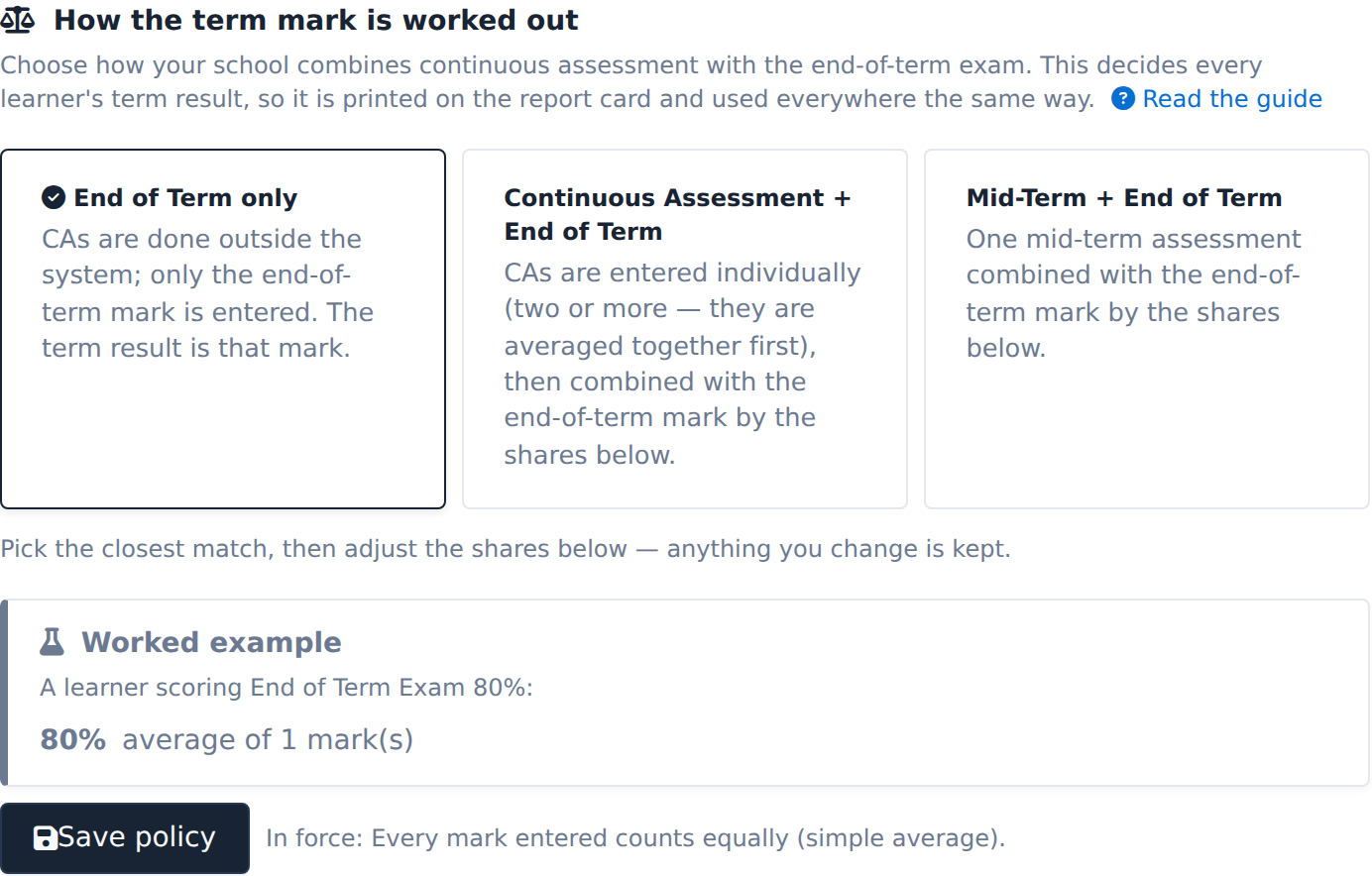
The three shapes
1. End of Term only
Your CAs happen in the classroom and the exercise book; only the end-of-term mark is typed into the system. The term result is that mark.
This is the default, and it is what most schools moving from a spreadsheet start with.
2. Continuous Assessment + End of Term
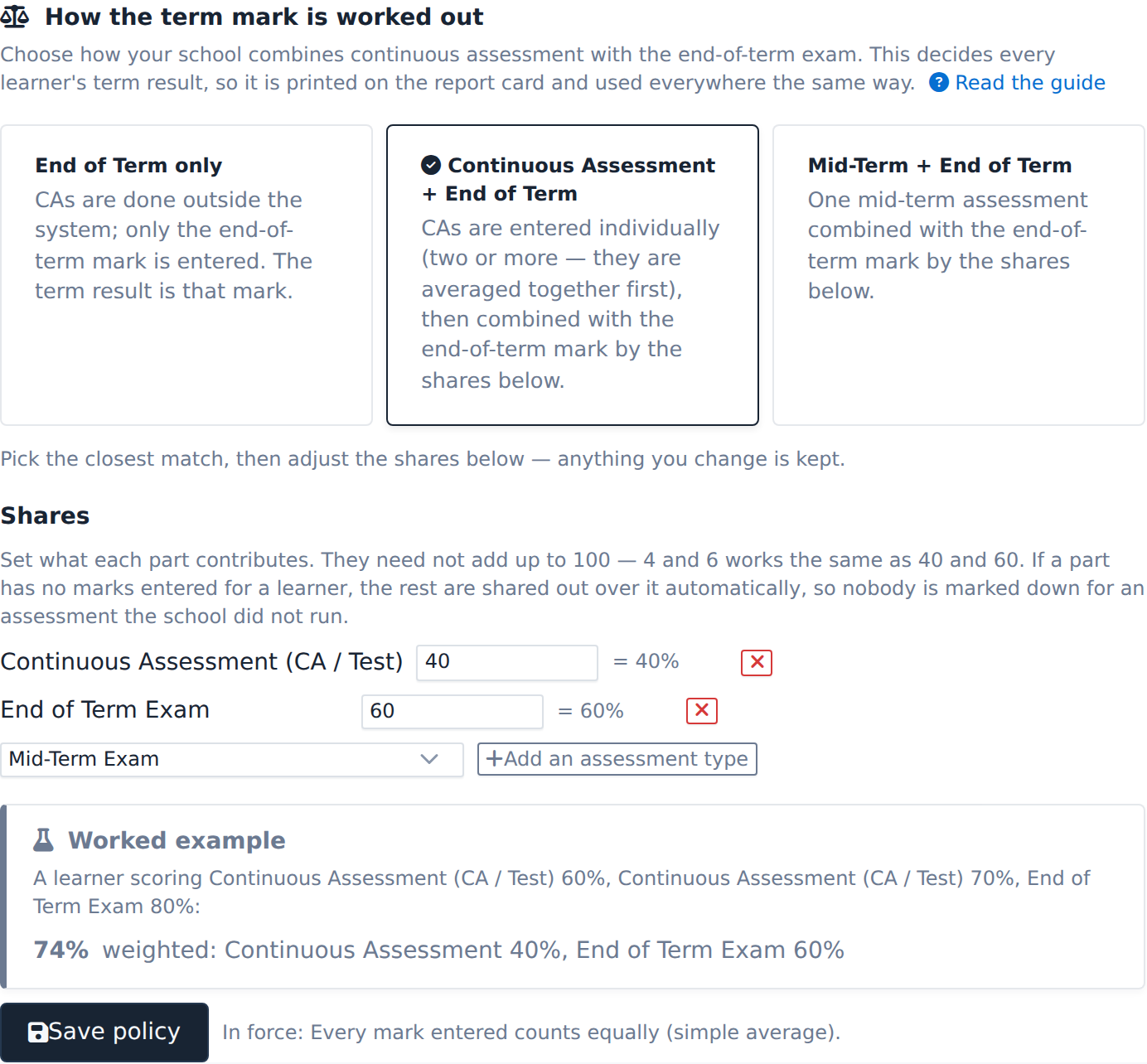
Each CA is entered on its own, then combined with the end-of-term mark by the shares you set. All the CAs are averaged together first, so it makes no difference whether you run two CAs or five — you never have to change the setting.
65 × 40% + 80 × 60% → term mark 74%
3. Mid-Term + End of Term
One mid-term assessment, combined with the end-of-term mark.
Setting the shares
Type what each part contributes. Two things worth knowing:
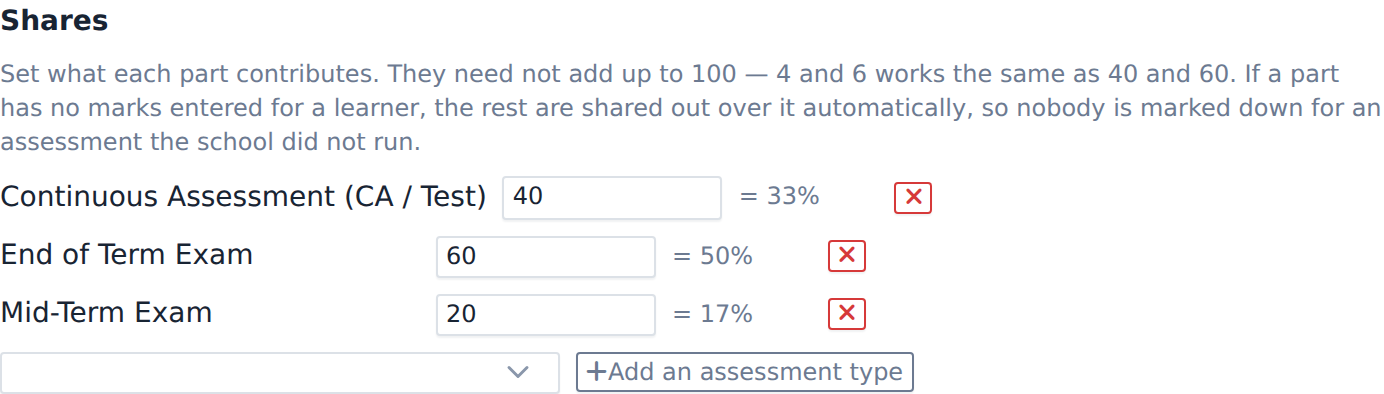
- They need not add up to 100. Entering 4 and 6 works exactly the same as 40 and 60 — ZamSkools works out the proportion for you.
- Three parts are available, because these are what Zambian schools actually grade a term on: Continuous Assessment (CA / Test), Mid-Term Exam and End of Term Exam. Use as many as your school runs, and leave out the rest.
What happens if a CA was not entered?
Nothing bad. If a learner has no CA mark for a subject, the remaining parts are shared out over what is there — so a learner is never marked down for an assessment the school did not run that term.
Learner has only End of Term 80 → term mark 80% (End of Term counts 100%)
The system also records that the CA was missing, so you can see it rather than wonder.

What this setting changes
| Where | Effect |
|---|---|
| Report cards | The subject total and the term average printed on every card |
| Class position | Rankings are computed from the same term mark |
| Growth Profile | Each subject's term-on-term journey uses these marks |
| Parent & pupil portals | Everyone sees the same number as the report card |
| SMS and USSD results | The same again — one rule, everywhere |
Who can change it
- Can change it: school administrator, head teacher, deputy head.
- Can see it: teachers, bursar and office staff — anyone who works with marks should know the rule in force.
- Cannot see it: parents and pupils. They see the resulting marks, not the settings.
Your policy belongs to your school alone. No other school can see it or change it, and yours is never affected by anyone else's.
Choosing well
- Start from what you already do. If your master sheet has one column per subject, you are shape 1. Do not add CA weighting just because it exists.
- Match the share to the effort. If CAs are two short class tests and the exam is a full paper, 30/70 usually reflects reality better than 50/50.
- Agree it once, school-wide. The setting is per school, so every class is graded the same way — which is exactly what makes class positions and growth trends comparable.